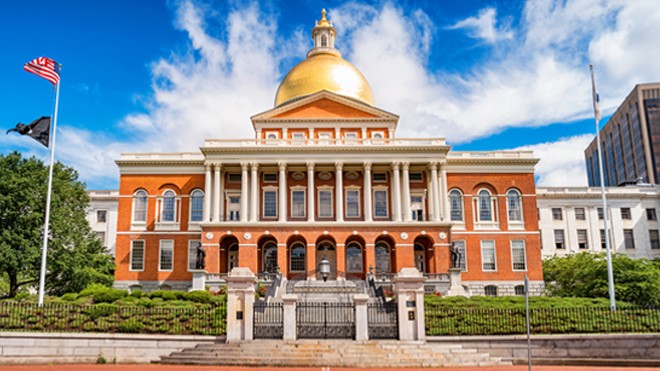
Representatives from Massachusetts news organizations testified before the Joint Committee on the Judiciary on July 15, urging lawmakers to pass long-overdue legislation that would protect journalists from being forced to reveal confidential sources.
The hearing focused on H. 1738 and S. 1253, companion bills that would establish a reporter shield law in Massachusetts, one of only nine states without such statutory protections.
Financial Burden on News Organizations
Fred Rutberg, president and publisher of the Berkshire Eagle and a retired state court judge, described how his newspaper spent $16,000 in legal fees fighting a subpoena in 2022. The case stemmed from an investigative story by reporter Larry Parnas about the Springfield Diocese’s handling of clergy abuse allegations.
Despite a judge ultimately finding the diocese’s request was a “fishing expedition,” the newspaper had to hire outside counsel and navigate multiple court proceedings to protect its sources.
“We were able to fight it and win. We could afford to do so, a lot of other newspapers couldn’t,” Rutberg told the committee. He noted that many Massachusetts newspapers are weeklies “hanging by their fingernails” that couldn’t sustain similar legal costs.
Dan Krockmalnic, chief operating officer and general counsel of Boston Globe Media and president of the Massachusetts Newspaper Publishers Association, said the Globe has filed more than a dozen motions in recent years to fight subpoenas for information about reporter sources.
“It’s a cost of doing business for us and we submit it shouldn’t be a cost whatsoever. It should be statutorily prohibited,” Krockmalnic said.
Impact on Public Interest Journalism
Walter Robinson, editor at large at the Boston Globe and former leader of the newspaper’s Spotlight Team, emphasized how confidential sources were critical to the Globe’s investigation into sexual abuse by Boston clergy.
“Much of the information that we received that helped us launch that series came from people who feared that their identities would become known,” Robinson testified. “I shudder to think what might have happened if they had remained silent.”
Karen Anderson, an investigative reporter with WCVB’s 5 Investigates, recalled how reporter Jim Taricani was sentenced to six months in jail in 2004 for refusing to reveal a source, and WCVB’s Susan Wornick faced jail time in 1985 in a similar situation.
“This is critical to preserving our ability to inform the public about the issues that many people in power would prefer to keep hidden,” Anderson said.
Current System Creates Uncertainty
Media attorney Jonathan Albano of Morgan Lewis illustrated the unpredictability of the current common law system by describing the Ayash v. Dana-Farber case, in which shifting court rulings led to contempt findings and a default judgment against the Globe, even though an appeals court ultimately found the source wasn’t relevant to the underlying claims.
“Having a shield law with clear standards avoids leaving these decisions to the discretion of a judge,” Albano explained.
Justin Silverman, executive director of the New England First Amendment Coalition, recounted how a small newsroom without resources to challenge a subpoena simply handed over a reporter’s notes without judicial review.
Overwhelming National Trend
Gabriel Rottman, vice president of policy at the Reporters Committee for Freedom of the Press, noted that 41 states and the District of Columbia now have shield laws, with Idaho unanimously passing strong protections in March 2025.
“The overwhelming trend across the country is toward enshrining protections for the free flow of information in law,” Rottman said.
The proposed Massachusetts bills would bar state officials from forcing journalists to name sources or disclose confidential newsgathering information unless necessary to prevent terrorism or imminent harm. They would also ensure journalists are notified before their records are sought and adopt a broad definition of journalist to cover anyone serving in a bona fide journalistic capacity.
The bills are endorsed by the ACLU of Massachusetts, Boston Globe Media Partners, Massachusetts Broadcasters Association, Massachusetts Newspaper Publishers Association, New England First Amendment Coalition, New England Newspaper and Press Association, and the Reporters Committee for Freedom of the Press.